If a dental implant is painful, loose, bleeding, repeatedly breaking, or simply does not look right, you do not have to live with the problem, and you do not have to start completely over.
Dental implant revision in Austin evaluates what went wrong, determines what can be saved, and creates a plan for repair or replacement.
At Austin Cosmetic & Implant Dentistry, Dr. Alexander Nguyen, a board-certified oral and maxillofacial surgeon, evaluates failing and failed implants with examination and 3D imaging. We also provide second opinions for dental implants placed at other offices, with no obligation to proceed with treatment.
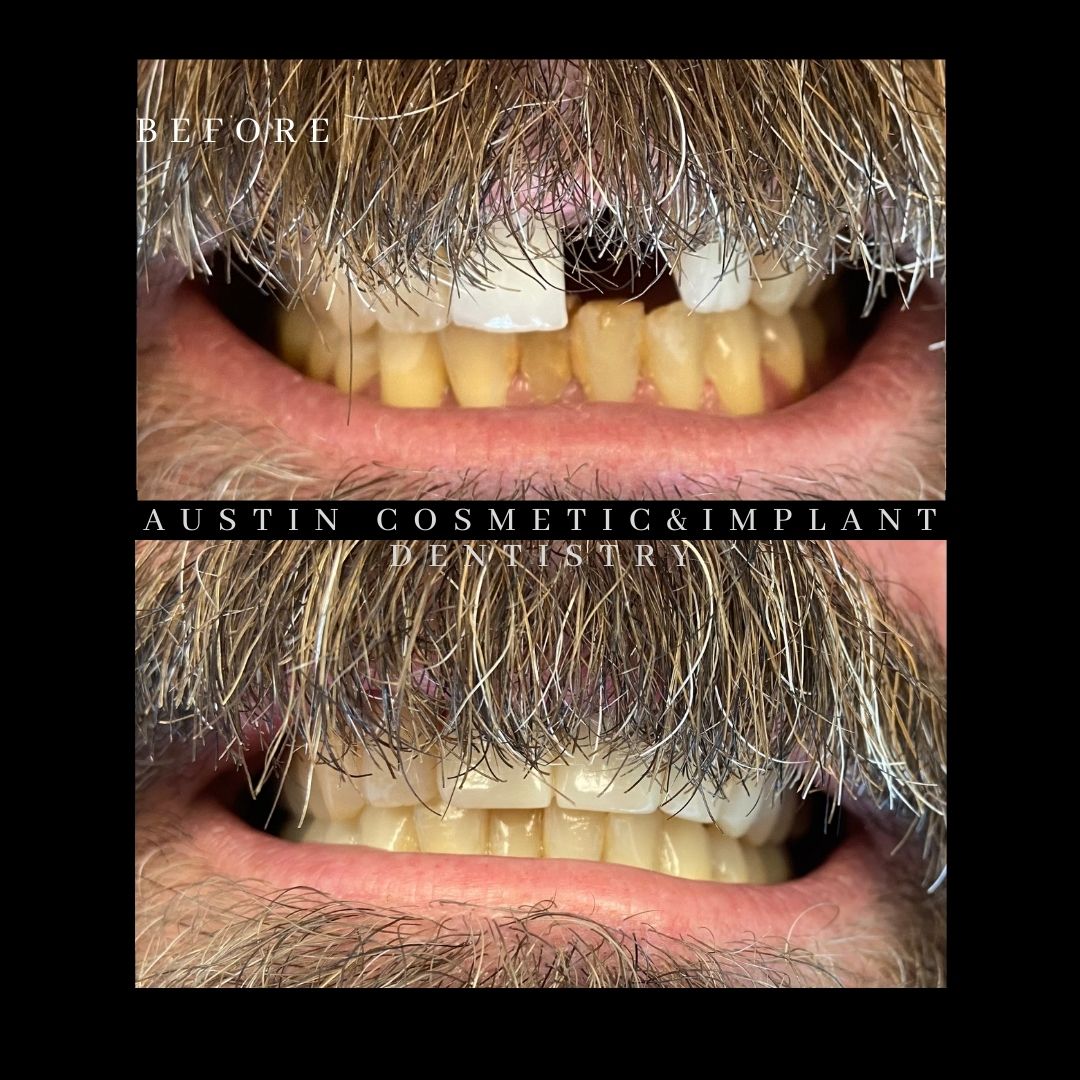
Dental implant revision is treatment for an implant or the crown, bridge, or full-arch teeth attached to it that are not functioning as they should.
Revision can range from treating inflammation around an implant that is still stable to implant removal and replacement in Austin when an implant has lost its connection with the bone. Sometimes the implant itself is healthy and only the restoration needs to be repaired or replaced.
The goal is not automatically to start over. The first step is determining what is sound, what can be saved, and what needs to change. Revision sits alongside our other implant dentistry services.
A dental implant that has healed normally should be stable and comfortable. Contact an implant specialist if you notice:
These symptoms do not automatically mean the implant has failed. An examination and 3D scan are needed to identify the cause.
A failed dental implant in Austin can have several causes, including:
Smoking, uncontrolled diabetes, and inadequate maintenance can also interfere with healing and increase the risk of complications.
The most important question is whether the implant can still be saved.
A failing implant may remain firmly integrated even though there is inflammation or some bone loss. Depending on the condition, treatment may include cleaning and decontaminating the implant surface, reshaping tissue for better access, grafting, and correcting the underlying cause.
A failed implant has lost its connection with the surrounding bone. If the implant itself moves, removal is generally necessary rather than allowing further bone loss.
| What you notice | What it often points to | Usual direction |
|---|---|---|
| Bleeding gum, no pain | Early inflammation around the implant | Often treatable, implant kept |
| Pus, swelling, bad taste | Established infection, likely bone loss | Treated promptly, depends on remaining bone |
| The implant itself moves | Loss of integration with bone | Generally removal and replacement |
| Fractured bridge, implants quiet | Material or bite problem, not implant failure | Often only the prosthesis is remade |
A CBCT scan and examination determine which applies to you. The table is a guide, not a diagnosis.
If your implant was placed at another dental office, you can still seek a second opinion for dental implants in Austin. It is a service in its own right, with no obligation to proceed.
We do not critique the dentist who treated you. We tell you where things stand and what your options are.
A revision consultation includes:
Bring previous records, scans, and implant information if you have them. If you do not, the 3D scan provides important information about the implant position and surrounding bone.
You can request a second opinion consultation without committing to treatment, and you are welcome to take the plan to your original dentist.
Treatment depends on what the evaluation finds.
Some implants can be replaced immediately, depending on the amount and condition of the remaining bone. Complex removals are handled through our oral surgery service.
Not every implant problem is an implant failure.
A crown that repeatedly loosens, a fractured full-arch bridge, or teeth that never achieved the desired appearance may be a restorative problem rather than an implant problem.
When the underlying implants are healthy, the solution may simply involve redesigning and replacing the crown, bridge, or full-arch prosthesis, without additional implant surgery.
If significant bone has been lost around a failed upper implant, conventional replacement may require bone grafting.
For some patients with severe upper jaw bone loss, other implant approaches may be considered, including zygomatic implants anchored in the cheekbone or pterygoid implants for additional posterior support. The appropriate option depends on your anatomy and 3D imaging.
Where an entire arch is involved, that conversation often turns to All-on-X in Austin.
Implant revision requires both surgical and restorative planning. Dr. Alexander Nguyen, a board-certified oral and maxillofacial surgeon, handles complex implant removal, grafting, and placement, while Dr. Madeleine Chung plans the restorative result.
Having the surgical and restorative teams work together helps ensure that implant position and final teeth are considered as one treatment plan.
IV sedation is available in-house for patients who are anxious about revision surgery or their previous dental experience.
Our Highway 290 location serves patients throughout Southwest Austin, including Oak Hill, Dripping Springs, and Bee Cave.
Can a failed dental implant be replaced?
In most cases, yes. The failed implant may be removed, the area cleaned and grafted when necessary, and a replacement implant placed after healing. Your scan determines the appropriate sequence.
Does removing a failed implant hurt?
Implant removal is often less involved than patients expect. Specialized instruments can sometimes remove a failed implant while preserving much of the surrounding bone. Local anesthetic or IV sedation can be used.
What is peri-implantitis?
Peri-implantitis is inflammation and infection around a dental implant that can lead to supporting bone loss. Early evaluation can help determine whether the implant can be preserved, and treatment generally includes cleaning the implant surface and correcting the underlying cause.
My implant feels loose. Does that mean it failed?
Not necessarily. A loose crown or bridge can result from a screw, cement, or bite problem. An implant that moves within the bone is a different concern and should be evaluated promptly.
How long before a new implant can be placed?
The timing depends on the amount of bone loss and whether grafting is required. Some implants can be replaced immediately, while grafted sites commonly need approximately three to six months to heal.
Can you revise an implant placed at another office?
Yes. A second-opinion evaluation can determine what can be retained and what needs to be changed, regardless of where the original implant treatment was performed. Bring previous records and scans if you have them, though a 3D scan can be taken here.
Will I be without teeth during revision?
Treatment is planned around maintaining your teeth during healing. Depending on the situation, a temporary tooth, bridge, or provisional appliance may be used, so a visible gap can generally be avoided.
How much does dental implant revision cost in Austin?
The cost depends on whether you need infection treatment, implant removal, bone grafting, replacement implants, or restorative work. A consultation and 3D scan allow a written treatment plan to be prepared.
If your implant is painful, loose, infected, or poorly functioning, dental implant revision in Austin, TX can determine what went wrong and what can be saved.
Dr. Alexander Nguyen can evaluate your implant with 3D imaging and explain your options in writing, with no obligation.
Austin Cosmetic & Implant Dentistry
13341 US Highway 290, Unit 1-107, Austin, TX 78737
Monday to Friday 8:30 AM to 4:30 PM, Saturday by appointment