If you have severe bone loss in the back of your upper jaw, conventional dental implants may require a sinus lift or bone graft before implants can be placed. Pterygoid implants in Austin offer another option.
These specialized implants anchor into dense bone behind and above the upper molars, often allowing patients to receive posterior implant support without a sinus lift.
At Austin Cosmetic & Implant Dentistry, Dr. Alexander Nguyen, a board-certified oral and maxillofacial surgeon, uses 3D imaging to determine whether pterygoid implants are appropriate for your full-arch treatment. They are one of the specialized techniques within our implant dentistry services.
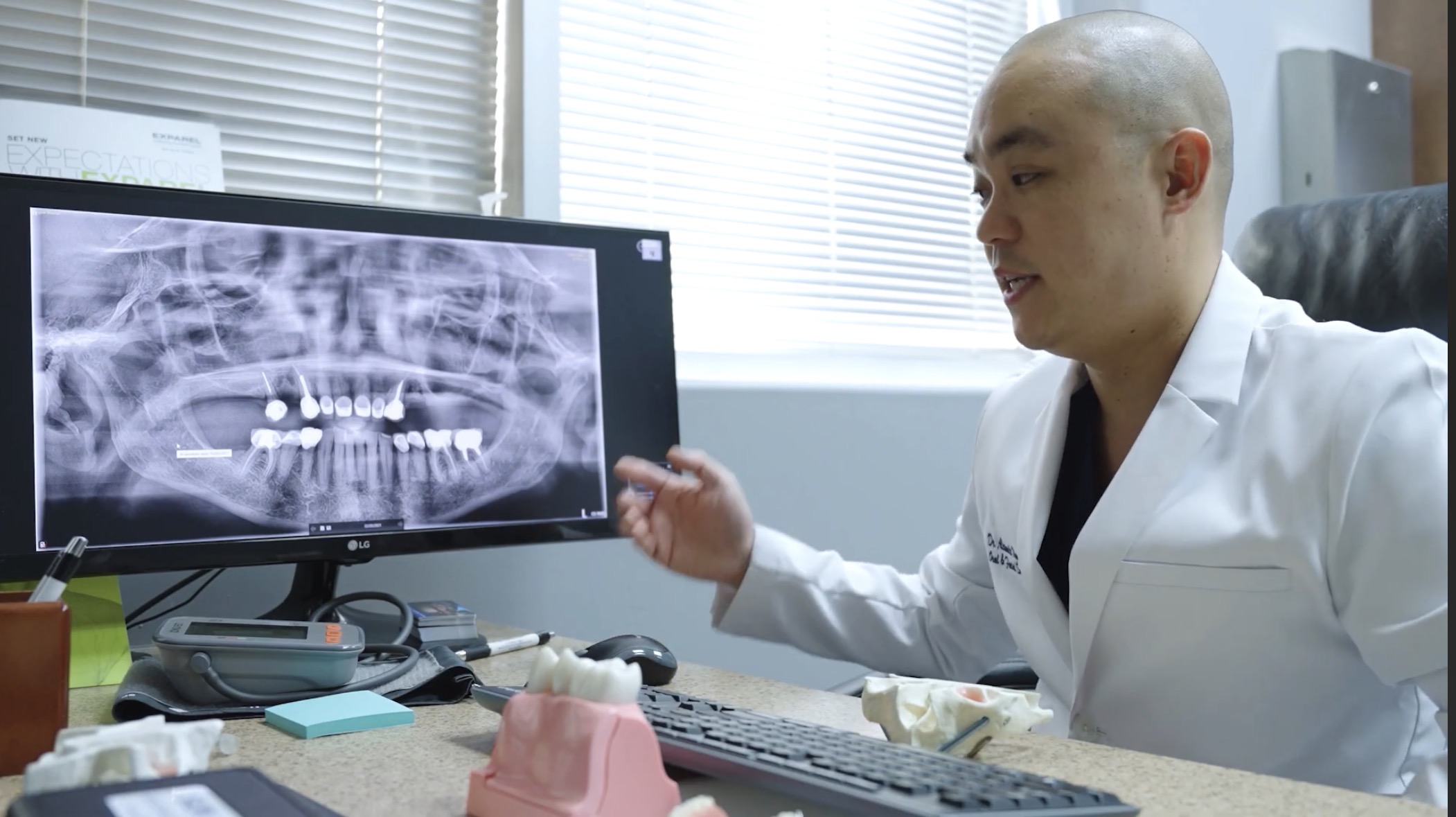
A pterygoid implant is a longer dental implant placed at the back of the upper jaw. Instead of being positioned directly beneath the sinus, the implant is angled backward into the maxillary tuberosity and pterygoid plate, areas of dense bone that can remain available even after significant tooth and bone loss.
That bone is not part of the tooth-bearing ridge, so it generally does not resorb after teeth are lost, the same principle behind zygomatic implant treatment.
Pterygoid implants are typically used as part of a full-arch dental implant treatment, with one implant commonly placed on each side to provide support at the back of the bridge.
One of the major advantages of pterygoid implants is that they can often avoid a sinus lift.
Traditional implants placed beneath a low sinus may require sinus augmentation and bone grafting before implant placement. Because pterygoid implants travel behind the sinus, a graft may not be necessary.
However, a sinus lift remains the better option for some patients. A 3D CBCT scan determines which approach is appropriate for your anatomy.
Pterygoid implants provide support toward the back of the upper jaw, allowing a full-arch bridge to extend closer to the natural molar position.
Without posterior support, the final teeth may need to extend beyond the last implant as a cantilever. A cantilever is an unsupported extension: the back teeth hang off the end of the last implant with nothing beneath them, like a diving board fixed at one end and free at the other.
A short cantilever is common and generally well tolerated. A long one is a mechanical liability. Each time you bite on the overhang, the force is magnified where the bridge meets the last implant, and over time that concentrated load is associated with loosened or fractured screws, chipped prosthetic teeth, and added stress on the implant furthest back.
There is a functional cost as well. Cantilevered teeth are typically kept short of molar position, so chewing may end at the premolars.
With pterygoid anchorage, the bridge can have more direct support at the back, potentially improving the mechanical design and chewing function of the full arch. Biting force then travels down into bone rather than along an unsupported arm.
Not every arch needs posterior anchorage. Many well-planned cases use a short cantilever without difficulty. Whether yours would be long is visible on the plan before surgery.
Pterygoid dental implants in Texas may be an option for patients who:
Candidacy is determined with a cone beam CT (CBCT) scan. The scan allows the implant team to evaluate bone density, the pterygoid region, sinus position, and the planned implant path.
Active sinus infection is treated first. Smoking, poorly controlled diabetes, and gum infection may affect healing and are generally addressed before surgery. If the front of the upper jaw has also lost most of its bone, pterygoid implants alone will not support an arch, and cheekbone anchorage may be recommended.
Both approaches can provide posterior support, but they solve the bone problem differently.
Pterygoid implants: Anchor behind the sinus and may avoid bone grafting.
Sinus lift: Raises the sinus membrane and adds bone beneath it before conventional implant placement.
Accepting a cantilever is the third option, and it is often chosen by default.
| Pterygoid Implant | Sinus Lift With Conventional Implant | Accepting a Cantilever | |
|---|---|---|---|
| Extra surgery required | No, placed in the same surgery | Yes, a separate grafting procedure | No |
| Healing time added | None beyond the implant surgery | Several months before implants | None |
| Posterior chewing support | Reaches closer to molar position | Reaches closer to molar position | Limited, teeth generally end sooner |
| Load on the last implant | Supported directly | Supported directly | Magnified by the overhang |
| Surgical complexity | Higher, requires specific training | Moderate, widely offered | Lowest |
Your treatment plan depends on your anatomy, bone availability, and the design of your final restoration.
Because pterygoid implants are placed deep at the back of the upper jaw, some soreness and stiffness when opening your mouth are normal during the first several days. Soft foods and following your post-operative instructions can support recovery.
In a same-day full-arch case, you may leave with a fixed temporary bridge, a sequence described on our teeth in a day page.
Long-term care is similar to other implant-supported bridges. Regular brushing, cleaning beneath the bridge, avoiding smoking, and professional maintenance are important for protecting your implants.
Pterygoid implants require precise three-dimensional planning and specialized surgical experience, and relatively few practices offer them. Dr. Alexander Nguyen, a board-certified oral and maxillofacial surgeon, evaluates the available bone and plans implant placement with the restorative team.
Because surgical and restorative care are provided under one roof, the implant positions and final bridge design can be planned together. The full-arch design itself is covered on our All-on-X page.
IV sedation is also available in-house, and your sedation options are reviewed beforehand. If you already have a treatment plan and want a second opinion, request a consultation and bring it with you.
Our Southwest Austin office serves patients from Oak Hill, Dripping Springs, Belterra, Circle C, Wimberley, and surrounding communities.
Can pterygoid implants replace a sinus lift?
Often, yes. Because the implant is positioned behind rather than beneath the sinus, a sinus graft may not be necessary. Your CBCT scan determines whether you are a candidate.
Can I get back teeth implants with little bone?
Pterygoid implants may provide posterior anchorage when conventional implants cannot be placed in the back of the upper jaw because of limited bone. A 3D scan confirms whether the bone behind the sinus can hold an implant.
Are pterygoid implants the same as zygomatic implants?
No. Pterygoid implants anchor in the pterygoid region behind the upper molars, while zygomatic implants anchor in the cheekbone. They address different areas of severe upper-jaw bone loss and are sometimes used together.
Can pterygoid implants be used with All-on-X?
Yes. Pterygoid implants are commonly incorporated into full-arch implant treatment to provide additional support toward the back of the bridge, which allows the design to avoid a long cantilever.
Will I be able to chew with molars again?
With adequate posterior support, the bridge can extend closer to the natural molar position, potentially providing more functional chewing support than a bridge that ends at the premolars.
How is candidacy determined?
A CBCT 3D scan evaluates the bone, sinus, and pterygoid region and helps determine whether the implant can be safely and predictably positioned.
Is recovery difficult?
Recovery is generally manageable, although patients may experience soreness and limited mouth opening for several days because of the location of the implant.
How much do pterygoid implants cost in Austin?
Cost varies based on your overall full-arch treatment plan, number of implants, restoration, and surgical requirements. A consultation and 3D scan allow the complete treatment plan and costs to be presented in writing.
If you have been told you lack enough bone for implants in the back of your upper jaw, pterygoid implants may be an alternative to a sinus lift or a long cantilever. Dr. Alexander Nguyen can review your 3D imaging and explain whether pterygoid anchorage suits your plan.
Austin Cosmetic & Implant Dentistry
13341 US Highway 290, Unit 1-107, Austin, TX 78737
Monday to Friday 8:30 AM to 4:30 PM, Saturday by appointment