If you have been told you do not have enough bone for dental implants in your upper jaw, this page is for you. That usually means years in an upper denture, advanced gum disease, a failed implant case, or bone lost after trauma or tumor surgery. You may still have an option for fixed teeth.
Zygomatic implants in Austin are specialized dental implants designed for patients with severe upper jaw bone loss. Instead of relying on the weakened jawbone, zygomatic implants anchor into the dense cheekbone (zygoma).
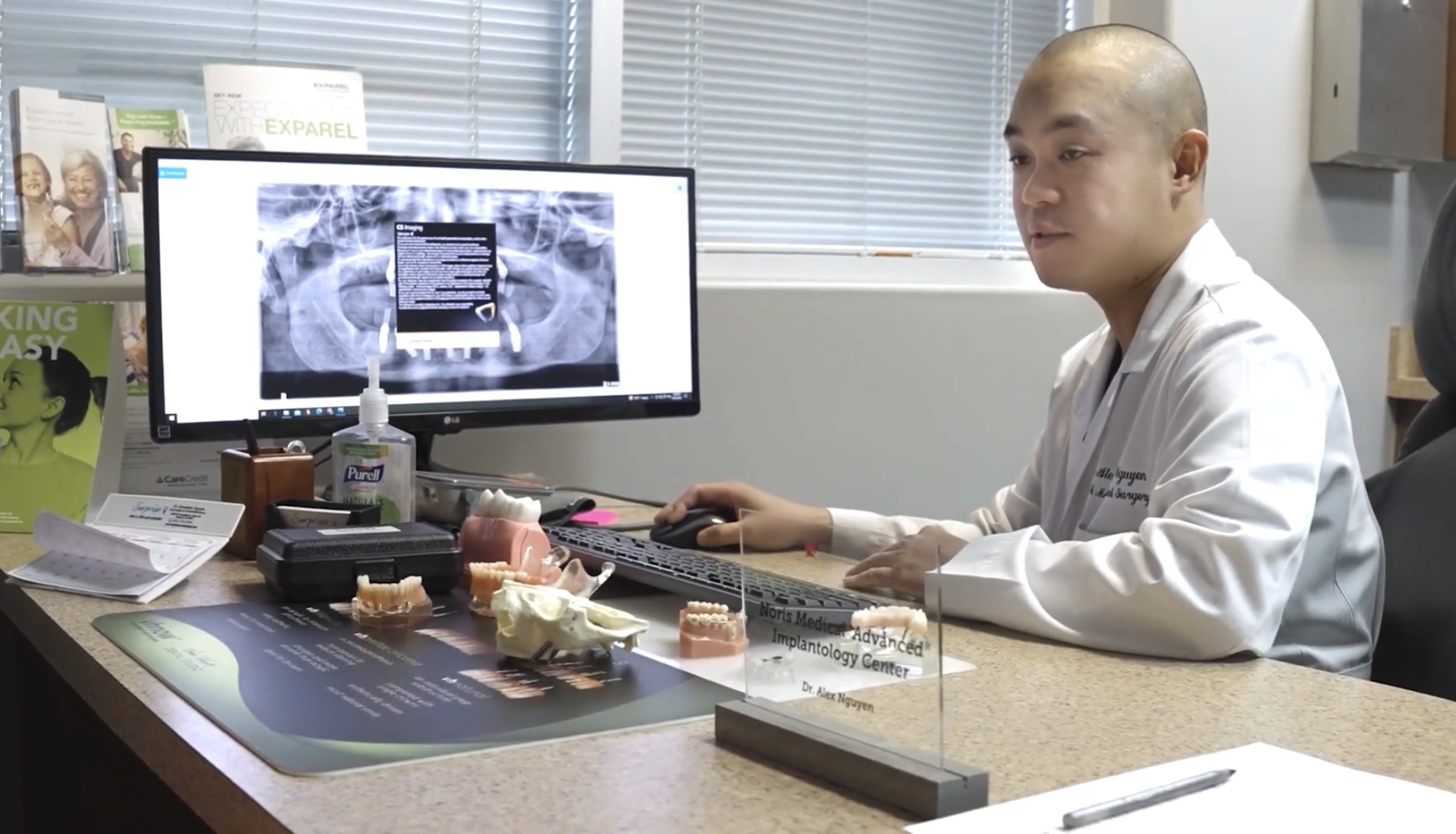
At Austin Cosmetic & Implant Dentistry, Dr. Alexander Nguyen, a board-certified oral and maxillofacial surgeon, uses 3D imaging to evaluate your anatomy and determine whether zygomatic implants are appropriate. They sit at the most advanced end of our implant dentistry services.
Unlike conventional dental implants that are placed into the jawbone, zygomatic dental implants are longer implants that extend from the upper jaw into the cheekbone. The zygoma is dense structural bone that typically remains available even when significant tooth-related bone loss has occurred.
The upper ridge that held your tooth roots shrinks once those roots are gone. The cheekbone never held teeth, so it generally keeps its density and can serve as an anchor point.
This approach can allow patients with severe upper jaw bone loss to receive a fixed full-arch restoration without extensive bone reconstruction.
One of the key advantages of zygomatic implants is the potential to avoid extensive bone grafting.
Traditional treatment for severe upper jaw bone loss may involve bone grafting and sinus procedures followed by months of healing before conventional implants can be placed. Zygomatic implants bypass the deficient upper jaw ridge and anchor in the cheekbone instead.
For appropriately selected patients, this can shorten the overall treatment timeline from years to months.
Zygomatic implants in Austin, TX may be considered for patients with:
Candidacy is determined using a cone beam CT (CBCT) scan, a low dose 3D scan that evaluates the cheekbones, upper jaw, sinuses, and planned implant paths.
Existing sinus disease, gum infection, smoking, poorly controlled diabetes, and certain medications may affect treatment planning and healing. If conventional implants with limited grafting or a sinus lift are a better option, that may be recommended instead.
The configuration depends on how much bone remains in the upper jaw.
Zygomatic implants with conventional implants: Two zygomatic implants may be combined with conventional implants in the front of the upper jaw, where usable bone typically remains longest.
Quad zygoma: When the front of the upper jaw also lacks sufficient bone, four zygomatic implants, two on each side, can support the upper full-arch restoration.
Zygomatic implants may also be combined with pterygoid implants to provide additional posterior support. The final bridge follows All-on-X full-arch design principles.
Zygomatic implant treatment involves detailed planning and advanced surgical techniques.
Your bone, sinuses, and medical history are evaluated.
Each implant path is planned according to your anatomy and final teeth.
Zygomatic implants are placed under IV sedation or general anesthesia. Surgery generally takes longer than conventional implant placement, and you will need a ride home.
When adequate implant stability is achieved, a fixed temporary bridge may be placed the same day.
Implant integration typically takes approximately four to six months.
Your permanent full-arch bridge is fitted and the bite is carefully balanced.
For patients with severe bone loss, there are different treatment approaches.
Zygomatic implants: Anchor into the cheekbone and can often avoid extensive bone grafting.
Bone grafting: Rebuilds deficient jawbone but may require multiple procedures and months of healing before conventional implants can be placed.
| Zygomatic Implants | Conventional Implants With Extensive Grafting | |
|---|---|---|
| Total treatment time | Commonly several months | Commonly a year or more |
| Number of surgeries | Usually one surgical phase | Often two or more, staged |
| Graft healing required | Usually none | Yes, months before implants |
| Immediate teeth possible | Frequently, when stability allows | Rarely, teeth generally come later |
| Suitability for severe bone loss | Designed for it | Limited by how much bone can be rebuilt |
| Surgical complexity | Higher, requires specific training | Moderate per stage, more stages |
Neither option is right for everyone. Your 3D scan and overall health determine which approach is appropriate.
Recovery is generally more involved than conventional implant surgery. Swelling and bruising around the cheeks and under the eyes are common and typically peak around the second or third day before gradually improving.
Patients may experience pressure, soreness, and temporary difficulty opening their mouths. A soft diet, proper oral hygiene, and following post-operative instructions are important during healing.
Because the implant path runs near the sinus, you may also be asked to avoid forceful nose blowing and straws for a period. Sinus irritation, temporary numbness of the cheek or lip, and the possibility that an implant does not integrate are reviewed with you before surgery.
Long-term care is the same as any implant-supported bridge. Brush twice daily, clean beneath the bridge, avoid smoking, and keep your professional maintenance visits.
Zygomatic implants require advanced surgical training, detailed 3D planning, and experience with the anatomy of the upper jaw, sinus, and midface. Relatively few surgeons in any market perform them.
Dr. Alexander Nguyen is a board-certified oral and maxillofacial surgeon who evaluates and performs complex implant procedures. Austin Cosmetic & Implant Dentistry also provides restorative implant care under one roof, allowing the surgical and restorative teams to coordinate the implant placement and final full-arch design.
IV sedation is available in-house for surgical procedures, and your sedation options are reviewed beforehand. If you would like a second opinion, request a consultation and bring your existing plan with you.
Our Southwest Austin office serves patients from Oak Hill, Circle C, Dripping Springs, Belterra, Wimberley, and surrounding areas.
Can zygomatic implants work if I have no bone?
They may. Zygomatic implants anchor into the cheekbone rather than relying solely on the resorbed upper jaw ridge. A CBCT scan is needed to determine whether your anatomy is suitable.
Can zygomatic implants avoid bone grafting?
Often, yes. Zygomatic implants can bypass areas with severe bone loss, potentially avoiding extensive grafting and the associated healing period. Limited grafting is still recommended in some cases, and your 3D scan shows which applies.
Can I get fixed teeth the same day?
In many cases, a fixed temporary bridge can be placed on the day of surgery when adequate implant stability is achieved. That is not possible for every patient. When stability is limited, the temporary bridge is delayed rather than rushed.
What is quad zygoma?
Quad zygoma uses four zygomatic implants, two on each side, to support a full-arch restoration when conventional implants cannot provide adequate support in the front of the upper jaw.
Are zygomatic implants painful?
Patients commonly experience pressure, soreness, swelling, and bruising rather than sharp pain. Your surgical team will provide post-operative instructions and medication guidance.
Do zygomatic implants go through the sinus?
Depending on your anatomy and surgical technique, an implant may pass alongside or through part of the maxillary sinus area. The implant path is planned using 3D imaging, and sinus health is evaluated before surgery.
How long does zygomatic implant treatment take?
The overall process commonly takes several months, with implant integration generally requiring approximately four to six months before the final bridge is completed.
How much do zygomatic implants cost in Austin?
The cost varies based on your anatomy, number of implants, extractions, anesthesia, and final restoration. A consultation and 3D scan are needed to create an individualized treatment plan and estimate in writing.
If you have been told you have insufficient bone for dental implants, you may have more options than conventional bone grafting. Dr. Alexander Nguyen can review your 3D scan and explain whether zygomatic implants, conventional implants, bone grafting, or another approach is best suited to your anatomy.
Austin Cosmetic & Implant Dentistry
13341 US Highway 290, Unit 1-107, Austin, TX 78737
Monday to Friday 8:30 AM to 4:30 PM, Saturday by appointment